The global vegetable oil market is dominated by four major players: palm oil, soybean oil, rapeseed oil, and sunflower oil. As the world’s population continues to grow and economies expand, the demand for vegetable oils has surged dramatically. These oils serve multiple purposes—from food consumption to industrial applications in soap, shampoo, detergents, cosmetics, pharmaceuticals, and increasingly important biofuel production.
However, amid growing environmental concerns and sustainability debates, palm oil has faced significant criticism from environmental groups. Many claim that palm oil plantations are the most expansive and environmentally destructive among vegetable oil crops. But is this narrative supported by facts? Let’s examine the data.
Palm Oil is the Most Land-Efficient Crop
Breaking Down the Numbers
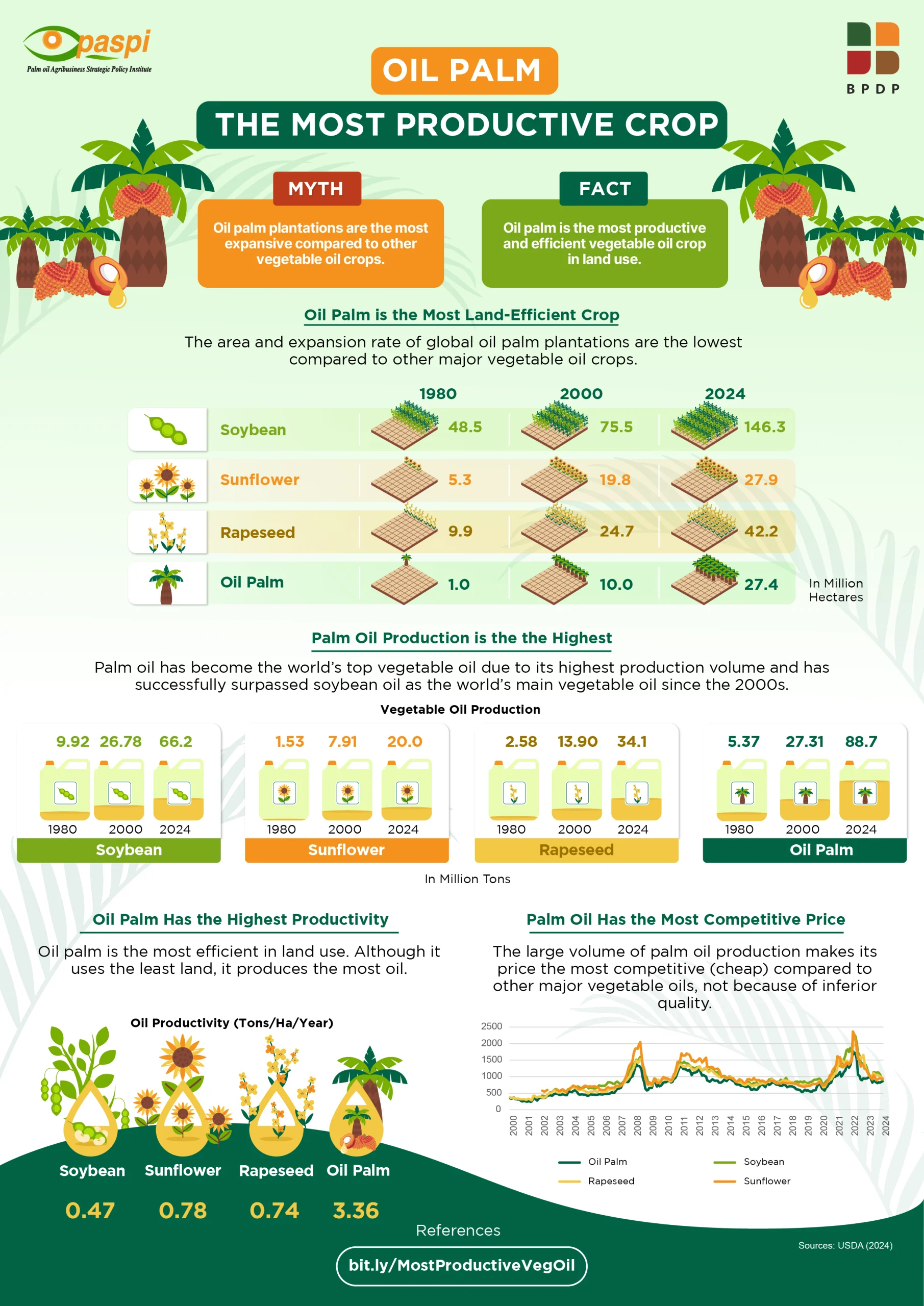
Contrary to popular belief, palm oil is actually the most land-efficient vegetable oil crop. The 2024 global planted area statistics reveal a surprising truth:
- Soybean: 146.3 million hectares
- Rapeseed: 42.2 million hectares
- Sunflower: 27.9 million hectares
- Oil Palm: 27.4 million hectares
These figures show that soybean plantations occupy more than five times the land area of palm oil plantations. Even more striking is the historical expansion data from 1980 to 2024, which demonstrates that soybean has experienced the most significant land expansion, not palm oil.
The Expansion Myth Debunked
From 1980 to 2024, the area expansion by crop shows:
- Soybean expanded from 48.5 to 146.3 million hectares
- Sunflower grew from 5.3 to 27.9 million hectares
- Rapeseed increased from 9.9 to 42.2 million hectares
- Oil palm expanded from 1.0 to 27.4 million hectares
While palm oil has indeed grown substantially (2,640% increase), it started from a much smaller base and still occupies the least amount of land among the four major oils.
Palm Oil Leads the World
Record-Breaking Production Volumes
Despite using the least amount of land, palm oil has become the world’s dominant vegetable oil by production volume. The 2024 production figures tell the story:
- Palm Oil: 88.7 million tons
- Soybean Oil: 66.2 million tons
- Rapeseed Oil: 34.1 million tons
- Sunflower Oil: 20.0 million tons
Palm oil successfully overtook soybean oil as the world’s primary vegetable oil in the early 2000s, and this dominance has only strengthened over time.
Unmatched Productivity Per Hectare
The secret behind palm oil’s success lies in its exceptional productivity. Oil palm delivers an impressive 3.36 tons of oil per hectare per year, significantly outperforming other crops:
- Oil Palm: 3.36 tons/hectare/year
- Sunflower: 0.78 tons/hectare/year
- Rapeseed: 0.74 tons/hectare/year
- Soybean: 0.47 tons/hectare/year
This means oil palm is more than four times more productive than sunflower or rapeseed, and over seven times more productive than soybean.
Competitive Pricing and Global Accessibility
Price Competitiveness
The large-scale production of palm oil has created significant economic advantages. The high production volume has made palm oil prices highly competitive compared to other vegetable oils—not because of inferior quality, but due to efficient production scale.
Year-Round Availability and Versatility
Palm oil offers several market advantages:
- Consistent supply: Available year-round
- Competitive pricing: Lower costs benefit global consumers
- Versatile applications: Suitable for food, industrial, and biofuel uses
- Global substitute: Can replace other vegetable oils in most applications
Land Efficiency Matters
The Conservation Argument
When evaluating environmental impact, land efficiency is crucial. To produce the same amount of oil as palm oil, alternative crops would require significantly more land:
- Soybean: Would need 7.1 times more land
- Rapeseed: Would need 4.5 times more land
- Sunflower: Would need 4.3 times more land
This land efficiency means that switching away from palm oil to other vegetable oils would likely result in greater overall deforestation and habitat loss.
Sustainable Production Practices
The palm oil industry has made significant strides in sustainable production through:
- Certification programs like RSPO (Roundtable on Sustainable Palm Oil)
- No-deforestation commitments
- Improved plantation management practices
- Biodiversity conservation initiatives
The Future of Palm Oil
Meeting Growing Global Demand
As global population approaches 10 billion by 2050, the demand for vegetable oils will continue to rise. Palm oil’s superior land efficiency makes it well-positioned to meet this demand while minimizing land use impact.
Innovation and Sustainability
The industry continues to invest in:
- Higher-yielding varieties
- Precision agriculture techniques
- Waste reduction technologies
- Renewable energy from palm waste
Facts vs. Fiction in the Palm Oil Debate
The data clearly demonstrates that palm oil is not the land-hungry crop that critics often portray. Instead, it’s the most land-efficient and productive vegetable oil crop in the world. While environmental concerns about palm oil production are valid and must be addressed through sustainable practices, the solution isn’t to eliminate palm oil but to produce it more responsibly.
Replacing palm oil with other vegetable oils would likely result in greater environmental impact due to the significantly larger land areas required. The focus should be on supporting sustainable palm oil production practices that can meet global demand while protecting forests and biodiversity.
For American consumers and businesses, understanding these facts is crucial for making informed decisions about vegetable oil sourcing and supporting truly sustainable practices in the global market.